
From Pages to Conversations: What AI search means for your brand

The web was built on pages. Now it's evolving into something more fluid, and the brands that learn to listen first will have a real advantage over those still optimizing pages that no one is clicking.
The web has mostly been static. Pages. Designed once, updated occasionally, built around what brands want to say rather than what people are actually asking. The page metaphor made sense when search was a list of links.
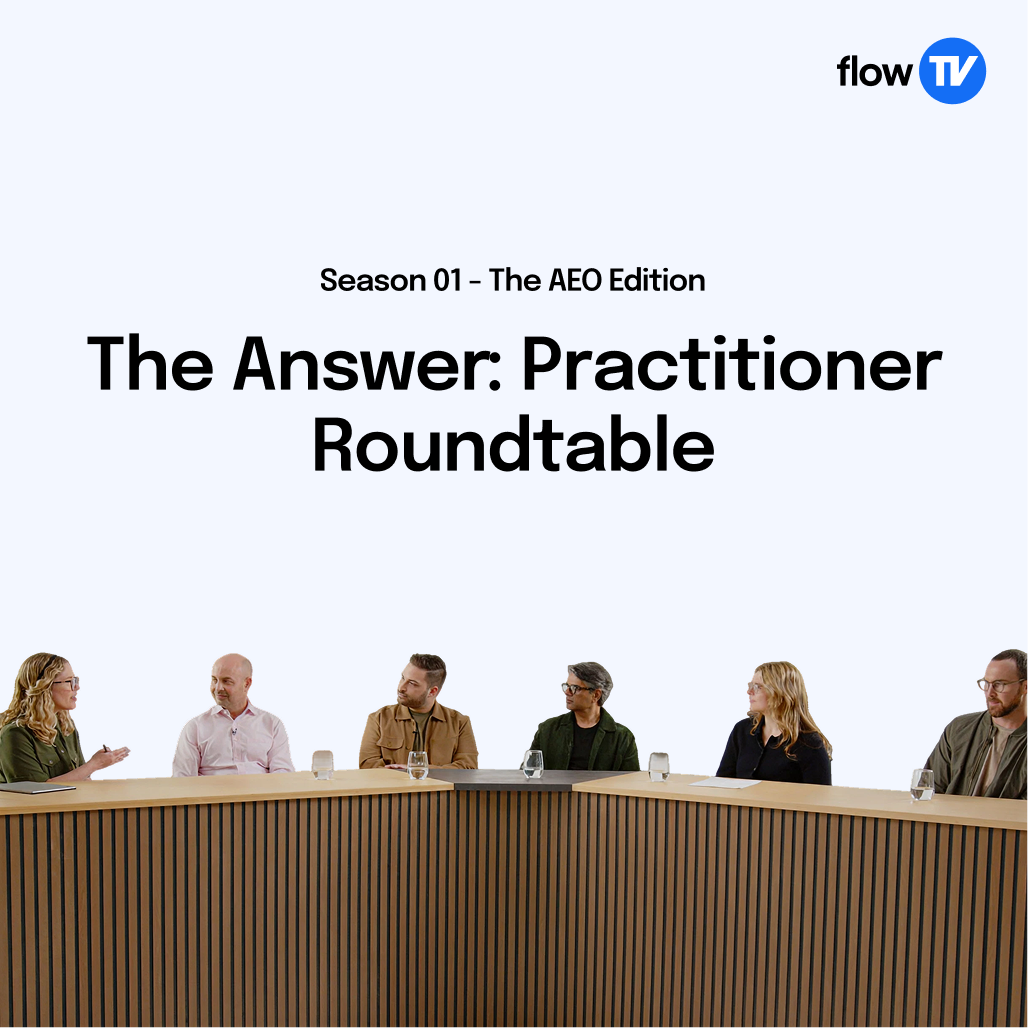
I had the chance to join a roundtable for Webflow's new Flow TV series this week, alongside five other practitioners who are living this question every day. The conversation surfaced something I keep coming back to: most companies think they're ready for AI-driven search, and the harder problem is that they're not sure what "ready" even looks like.
The conversation about your brand is already happening
At Zero Click by Profound last week, Dan Morrill, VP of Marketing Technology at LinkedIn, shared that 94% of B2B buyers are using AI before they ever engage a sales team. Think about that for a moment. The discovery process, the part where buyers form opinions, compare options, and decide who's worth talking to is increasingly happening inside ChatGPT, Perplexity, and whatever tool your buyer opened before they found you.
That gap from 3.5 words to 60 is a signal that people are arriving with richer context, more specific problems, and higher expectations.
"You're trying to do two things. You're trying to get discovered and you're trying to get chosen. Everything sort of falls into those two buckets."
Roundtable panelist:
- Uzair Dada, Founder & CEO, Iron Horse
The page metaphor is giving way to a conversation metaphor
One of the sharpest observations from the roundtable came from Alexander Diner, who asked a genuinely unsettling question: when you strip away your logo, your colors, everything that makes your brand visually distinct, are you still distinct when it's just text on a screen?
For decades, B2B marketing has been a page metaphor. We design pages, we optimize pages, we update pages. But AI search synthesizes answers, and in that synthesis, the brands that win are the ones that get included in the conversation.
This requires a different starting posture. Conversations start with listening. You have to understand what people are asking, how they're framing the problem, and what language they're actually using before you can respond in a way that earns a place in the answer.
"The irony of this moment is that AI being able to touch everything is actually forcing us to be more human, to speak in human language, to show up in a more human way."
Roundtable panelist:
- Alexander Diner, Head of Brand Studio at Webflow
What practitioners are actually doing
The roundtable was honest about how messy this is in practice. There's no consensus playbook, but a few throughlines kept surfacing:
1. Listen before you optimize. Josephine Cahill's team scrapes call recordings every week, pulling out what questions were asked, what competitors were mentioned, and critically, how buyers describe the problem in their own words. That language becomes the foundation for content, not the other way around.
2. Someone has to own this. Josh Jacobs put it plainly: if everyone owns AEO, nobody does. The brands moving fastest have assigned clear ownership, defined metrics, and a process for acting on what they're learning, not just monitoring scores.
3. Think distribution shift, not channel shift. Josephine's framing stuck with me: AEO is a shift in how content gets distributed and surfaced. The underlying job, creating content that answers real questions with authority, is the same. The distribution layer is what's changing.
4. Quick fixes don't compound. Adding an FAQ here or a schema tag there is, as Josh described it, a salve on the wound. The work that actually matters is organizing content so it tells a cohesive story, one that an AI can faithfully represent when someone asks about your category.
5. Be specific about what you're not. Point on this was counterintuitive but sharp: brands that clearly articulate what they're not good at actually guide LLMs more effectively. Clarity of positioning, including the edges, creates a sharper, more accurate representation in AI-generated answers.
Visibility and speed are the new competitive advantage
Tools like Webflow AEO are making it possible for marketing teams to see which prompts their brand actually appears in, understand what to fix, and ship improvements without bouncing between five different platforms. That combination, visibility into the AI conversation and the ability to act on it quickly, is becoming a genuine competitive edge.
The brands that learn to listen first, build content that earns a place in the answer, and move fast when they find the gaps will have a real advantage over those still optimizing pages that no one is clicking.
This article is based on Mason Poe's appearance in Season 1, Episode 1 of Flow TV - Webflow's new video series on AI-driven marketing and the future of web. The episode features Josh Jacobs, Uzair Dada, Josephine Cahill, and Alexander Diner, moderated by Jess Fain. Watch the full episode on Webflow's site.