
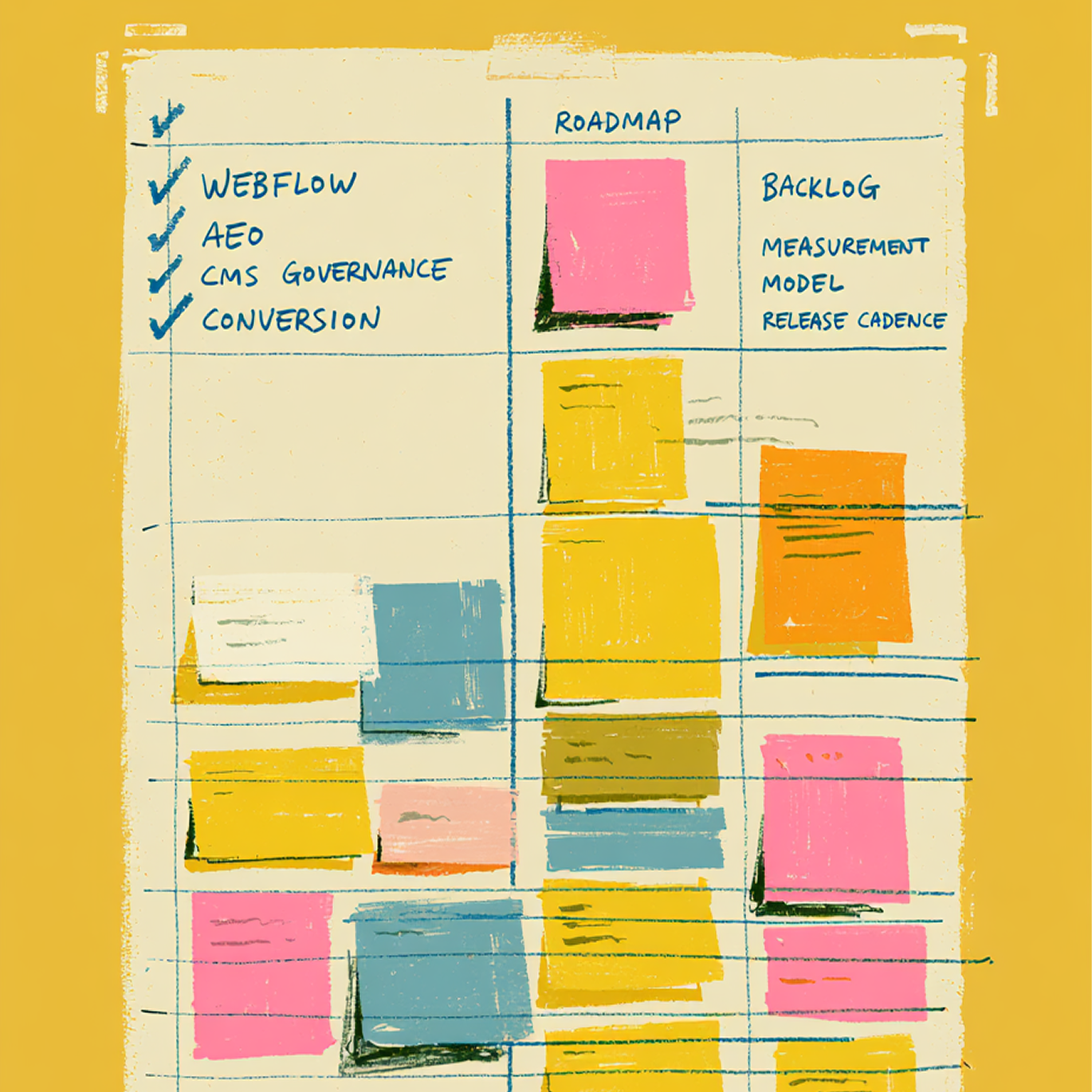
Why the Next Wave of Enterprise Webflow Work Looks Like Product Management

- The next enterprise Webflow brief will look less like a redesign and more like a product roadmap. Launch is becoming the starting line for a much longer engagement.
- A Webflow product operating model requires a named owner, a 6-to-12-month roadmap, a release cadence, CMS governance, AEO monitoring, and conversion experiment tracking, all running in parallel.
- The right enterprise Webflow partner after launch measures what improves in months three, six, and twelve, against baselines set at launch.
Part 2: The operating model, the roadmap structure, and what a mature post-launch SOW should include.
Read Part 1: What an Enterprise Webflow Partner Should Deliver (From 10+ Years of Building Them)
The next enterprise Webflow brief will look less like a website project and more like a product roadmap.
That shift is underway. Webflow Enterprise keeps shipping AI assistants, AEO features, custom AI credits, global hosting upgrades, editor workflows, and tighter design-to-development handoffs, all at a pace that assumes someone on your side is managing the site as a living system that keeps evolving well past launch.
However, most enterprise teams are still running web projects on a build-launch-maintain model that made sense when a website was a finished deliverable. It stops working the moment AI search rewrites discovery patterns every quarter and your team is still calling the agency to publish a campaign page.
The companies getting the most out of enterprise Webflow are the ones whose sites keep getting better after launch, because someone owns the roadmap.
What changed: Webflow is becoming an operating platform
Most enterprise teams assign a project manager to the Webflow build, but rarely name a product owner after launch, and that's where sites stall: six months on, marketing is still waiting on the agency for new pages, AEO monitoring is ad hoc, and conversion data sits in a dashboard nobody's reviewed.
Treat your Webflow build as a product with an operating model, and here are the pieces that matter:
- Roadmap: A 6-to-12-month view of what gets built, in what order, and why. Prioritized against business outcomes, not requests from whoever has the loudest voice in Slack. The roadmap is how you get intentional about decisions instead of reactive.
- Backlog: Where performance signals, content needs, stakeholder requests, and conversion data go before they become work. A well-structured backlog is the difference between a site that improves systematically and one that accumulates debt.
- Release cadence: How changes move from idea to staging to live, with a defined QA process, a rollback plan, and a post-launch monitoring window that make every release less risky and less stressful.
- Measurement model: Track organic traffic by cluster, AI citation share, Core Web Vitals, assisted conversions, editor publishing speed, and content production cycle time, not vanity metrics. Set the baselines at launch and review them monthly.
- AEO monitoring: AI search is changing which pages are cited, which brands are named, and which answers are surfaced. Use it as an ongoing signal that feeds the backlog directly. See how we structure this via our AEO audit.
- CRO experiment tracking: Conversion data is roadmap input, and post-launch CRO is how you act on it systematically instead of reactively. If a landing page is getting traffic and not converting, that's a backlog item.
- CMS governance and editor enablement: Who can publish what, with what approval path. Editor training that reduces agency dependency. Role-based publishing rules that protect the design system without creating bottlenecks.
A maintenance retainer and a product operating model aren't the same commitment. The difference shows up fast when you put them side by side:
AI search makes brand clarity a technical requirement
AEO monitoring is one line in that operating model above, but it only works if there's a consistent story underneath the site to monitor. If your content model, internal links, page hierarchy, and metadata don't point to the same story, no amount of AEO optimization will fix it: that's a brand problem showing up as a technical one, and it has to be solved upstream first.
AI systems build a model of who you are from your brand language, page hierarchy, internal link structure, schema, and structured content, then resolve whether those signals tell one consistent story or several competing ones. Give a model four different ways to describe what you do, and it will average them into a version you'd rarely choose.
If an AI system cannot explain your company in one sentence, your site is giving it too many versions of the truth.
This is where Story Engineering comes in: Edgar Allan's upstream process for turning brand language into structured source material before a page gets designed or a template gets built. It defines what the company does, who it serves, how it talks, and which pages deserve to rank and get cited. That material flows directly into web architecture, AEO, and CRO. It's the foundation the rest of the site work sits on.
If you're already live on Webflow, that's worth auditing before you spend more budget on technical fixes. Our AEO content covers the mechanics in detail, or start with a brand clarity assessment to see where the story is fracturing.
A Webflow site has several users after launch
One of the things that makes enterprise Webflow product management different from the maintenance model is the number of stakeholders who become users of the system after launch.
Marketing editors need to create campaign pages and update content without opening an agency ticket for every variation, and product marketing needs that same speed for landing pages, comparison pages, and messaging updates as the product evolves. Legal needs approval paths before anything with regulatory implications goes live. IT wants access control, SSO documentation, and audit confidence, while executives are looking for reporting tied to pipeline, visibility, and conversion, numbers built for board decks and revenue conversations. Edgar Allan built its own SOC 2 attestation for this reason: enterprise IT teams need documented, independently verified security discipline in a partner.
Migration is product release management
Enterprise Webflow migrations work best as a product release event planned from the start.
That means defining acceptance criteria before the migration starts: mapped and validated redirects, canonical tags and structured data, an analytics baseline, and a rollback plan for cutover, plus search equity tracking from before launch so you measure what's retained instead of guessing.
The migrations that lose search equity almost never come down to a handful of missing redirects. They come down to misconfigured ones: chains, loops, wrong destinations, canonicals still pointing to staging. The technical list is short, but the execution discipline is what separates a clean migration from three months of recovery.
A well-run migration is a launch event with a release plan, a QA checklist, and a 90-day monitoring window, and the risk drops accordingly.
If you're still building your shortlist, our rankings of the best Webflow agencies for enterprise work cover how to evaluate migration maturity across the field.
Component-first architecture is product infrastructure
A component library is the site's product interface. A component-first build lets editors compose new pages from existing parts and launch campaigns without developer support; a template-based build creates a bottleneck the moment marketing needs something the original templates didn't anticipate.
The right framing shifts the question from whether you can launch this page to whether the team can build the next fifty pages without opening a new agency ticket.
On Walker & Dunlop's site, that architectural shift showed up directly in the numbers: build times for new pages fell from months to days, content updates increased tenfold, and update lead time dropped from more than 10 business days to under one, all without engineering support.
For enterprise teams with multiple product lines, regional variations, or high-velocity campaign needs, this architectural difference is the single biggest driver of how much value they get from the site in year two.
AEO and CRO belong in the same backlog
The cleanest way to slow down an enterprise Webflow program is to run AEO and CRO as separate workstreams with separate reporting cycles and no shared prioritization.
A page needs to get understood by AI systems, rank in search, earn buyer trust, and convert, all at once, on the same page. Treat those as separate programs, and it gets analyzed twice, optimized for conflicting outcomes, and updated without a shared view of what's working.
Those metrics belong in the measurement model above, tracked in one dashboard and feeding one backlog.
The backlog item might look like: pricing page is getting organic traffic but not converting, and Ag-nts shows it's getting AI referral traffic that's bouncing. Hypothesis: the page is being cited for questions our pricing doesn't answer well. Test: restructure the comparison section and add FAQ blocks that address the most common objections from sales calls. That's an AEO and CRO problem solved with one backlog item, one experiment, and one measurement window.
The next enterprise Webflow SOW should scope the operating model
Most enterprise Webflow SOWs are built around the build phase. Scope, timeline, deliverables, handoff. What happens after launch is usually either a maintenance retainer with vague scope or a follow-on engagement that hasn't been defined yet.
A product-management operating model makes the post-launch scope explicit from the start: the roadmap, backlog, release cadence, AEO monitoring, CRO tracking, and CMS governance all belong in the SOW. What a contract adds on top:
- Migration KPIs and a 90-day measurement window after launch.
- SLA tiers for bugs, campaign support, and net-new page builds.
- Editor training with defined self-sufficiency milestones.
- Security, SSO, and compliance task ownership.
- Webflow Enterprise support escalation process.
This is a clearer contract that changes the relationship from vendor to partner, because both sides know what success looks like and can see whether they're hitting it.
Edgar Allan treats brand, architecture, and optimization as one system
Edgar Allan's Visibility Engineering and Optimization methodology exists because brand, web architecture, AEO, and CRO are one linked system, and Story Engineering is what keeps that system legible to AI models, customers, and the internal teams executing at scale.
For enterprise Webflow clients, that methodology becomes a post-launch operating model: a roadmap, a backlog, a measurement model, and a named owner at every stage. The build delivers the foundation, and the operating model is where the investment compounds.
If you're evaluating enterprise Webflow partners or rethinking how your current site gets managed after launch, the question worth starting with is: who owns the roadmap?
If your answer to that question is "nobody yet," let's talk.
FAQs
What should ongoing support for an enterprise Webflow site include after launch?
It's the post-launch framework that runs the site as a managed product rather than a finished deliverable: a 6-to-12-month roadmap, a prioritized backlog, a release cadence with QA and rollback processes, a measurement model tied to business outcomes, AEO monitoring, CRO experiment tracking, CMS governance, and editor enablement. Without it, sites improve sporadically instead of systematically, and the build's value erodes over time. The gap usually shows up as the same story: a site that looked finished at launch and quietly falls behind competitors who kept shipping.
Do I still need an agency after my Webflow site launches?
A maintenance retainer keeps a site stable. A product operating model is what makes it improve, adding roadmap prioritization, conversion testing, AEO monitoring, component library expansion, CMS governance, and measurement against defined business outcomes. Most contracts default to the retainer model because it's easier to scope. The practical difference shows up within six months, when a retained site has stayed stable and an operating-model site has measurably improved.
Why does brand consistency matter for AI search on an enterprise Webflow site?
AI systems build a model of your brand from every signal on your site: page hierarchy, internal links, schema, metadata, and brand language. Inconsistent signals get resolved by averaging, which usually produces a generic, inaccurate version of your brand. Story Engineering defines a consistent brand story before those downstream signals are set, so AI systems get one clear version of the truth instead of several competing ones.
How does Edgar Allan measure post-launch Webflow performance?
Edgar Allan tracks organic traffic by content cluster, AI citation and mention share through Ag-nts, branded search lift, Core Web Vitals, form conversion rates, and assisted conversions. The specific mix depends on the client's goals, but every engagement starts with agreed baselines set at launch, reviewed monthly against what's actually moving instead of what looks good in a dashboard. A monthly review might show AI referral traffic climbing on a page while its conversion rate drops, which becomes a backlog item rather than a metric nobody acts on.